-
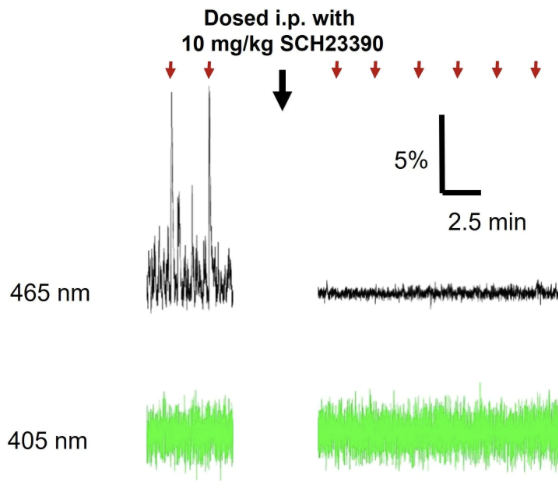
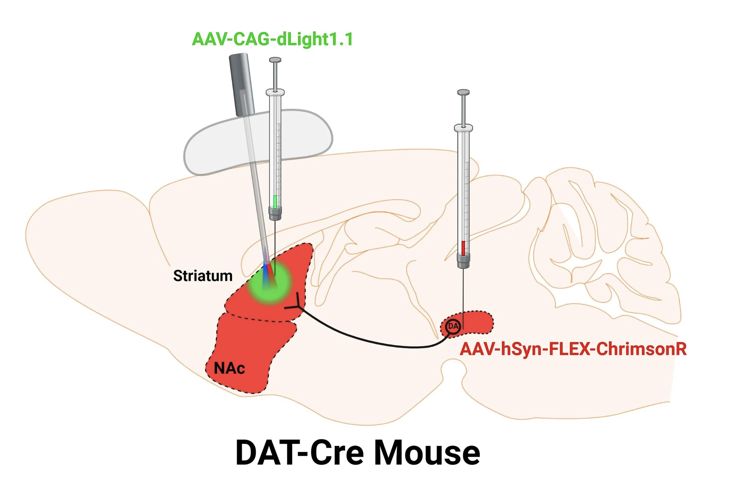
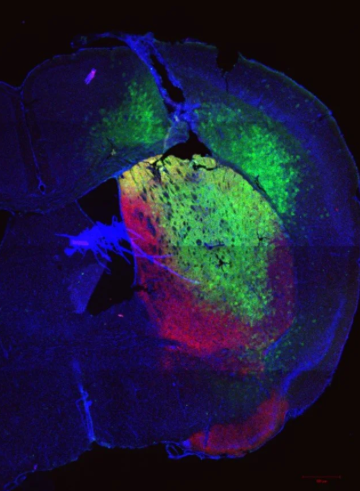
Fiber photometry lets us record the activity of specific neurons, or the release of specific neurotransmitters, in real time as an animal moves and behaves freely. A hair-thin optical fiber implanted in the brain collects fluorescent signal from genetically encoded sensors, so we can capture brain activity during natural behaviors rather than under anesthesia.
-
Fiber photometry uses fluorescent sensors to track changes in neural activity in specific populations of brain cells. Light is delivered through an implanted optical fiber, which also collects the resulting fluorescence signals so neural activity can be measured in real time.
-
Fiber photometry lets us ask how specific brain circuits are engaged during natural behaviors, and how drugs change that activity, in awake, freely moving animals. In our lab, we use it to study how circuits are regulated during repetitive behaviors such as grooming, and how pharmacological treatments modulate those circuits.
Fiber Photometry
-
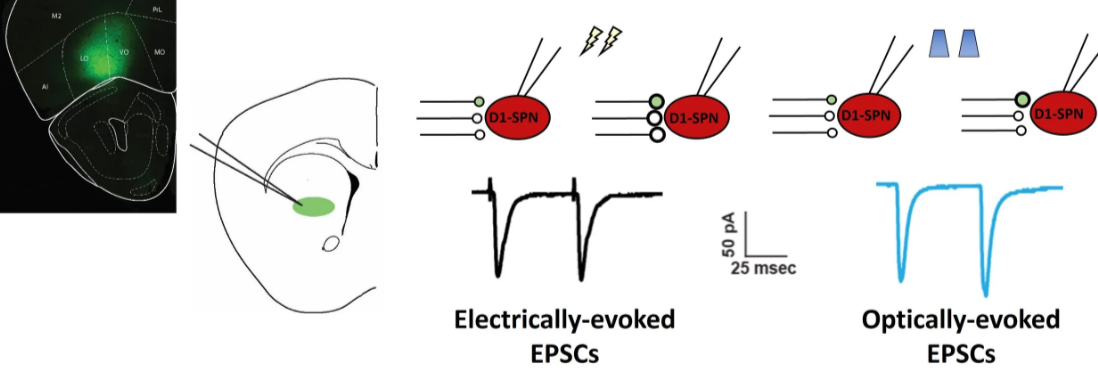
In our lab, we use whole-cell patch clamp electrophysiology to characterize how CB2 receptors influence dopamine neurons. This technique enables us to measure the electrical activity of individual neurons in real time, providing insight into how CB2 receptors regulate neuronal signaling.
-
Brain slices are placed on an electrophysiology rig beneath a high-powered microscope, where a fine glass micropipette is guided to an individual dopamine neuron, allowing us to record its electrical activity in real time.
-
By measuring the electrical activity of individual dopamine neurons, this technique allows us to investigate the function of CB2 receptors in the brain. Our research aims to determine how these receptors influence neuronal signaling and whether they may represent a novel therapeutic target for schizophrenia.
Electrophysiology
-
Behavioral pharmacology investigates how drugs influence behavior and brain function, providing insight into the neural mechanisms that underlie both normal behavior and psychiatric disorders.
-
In behavioral pharmacology, researchers administer a drug to an animal and observe how its behavior changes. One common measure is distance traveled, which reflects the animal's level of activity. For example, amphetamines increase movement, producing a response known as hyper-locomotion. Researchers can then test other compounds to determine whether they reduce or block this effect. These studies help scientists understand how drugs influence brain function and identify potential treatments for neurological and psychiatric disorders.
-
In our lab, we use behavioral pharmacology because many of the psychiatric disorders we study have measurable behavioral outcomes. By observing how animals behave after receiving different pharmacological compounds, we can investigate the underlying neural circuits involved in these conditions. This allows us to better understand how changes in brain circuitry contribute to behavioral symptoms and evaluate potential treatments that target these pathways.
Behavioral Pharmacology